🌱 Why Does My Lawn Have Bare Patches? (And How to Fix Them This Spring)
Bare patches are feedback, not failure: every one of them has a specific, identifiable cause, and every cause is fixable, especially in spring.
A patchy lawn is rarely random. Once you learn to read the clues, those bare spots will tell you exactly what went wrong and how to fix it for good.
There is a particular kind of frustration that comes with a lawn full of bare patches. The rest of the grass looks reasonably healthy, you water it, you mow it, and yet those same stubborn spots stay brown, thin or completely bald. You reseed them, they green up for a few weeks, and then they fade again as if nothing happened.
🌱 Why Does My Lawn Have Bare Patches? (And How to Fix Them This Spring)
If this sounds familiar, here is the good news: bare patches in a lawn almost always have a specific, identifiable cause. They are not bad luck, and they are rarely a sign that your whole lawn is failing. They are more like symptoms, and just as a doctor would not treat a cough without asking what is causing it, you should not patch a lawn without working out why the grass died there in the first place.
With spring now underway in Sydney, this is the single best window of the year to diagnose and repair a patchy lawn. Warm-season grasses are waking up, soil temperatures are rising, and new growth can establish before the harsh heat of summer arrives. In this guide, we will walk through the most common suspects behind bare patches, teach you how to identify which one is at work in your lawn, and show you how to repair the damage so it actually stays repaired.
🔍 Why Do Bare Patches Appear in the First Place?
Grass dies in patches when something in that exact spot is different from the rest of the lawn. That sounds obvious, but it is the key to the whole diagnosis. Sunlight, soil condition, water, traffic and pests are almost never spread evenly across a yard, so the grass responds unevenly too.
Think of your lawn as a map of everything that happens on it. The route your family walks to the clothesline, the shadow your fence casts in winter, the corner where the dog does its business, the spot where rain sheets off the roof. Each of these leaves a signature on the grass, and bare patches are simply the places where the pressure became too much.
Here is a quick test before we go further: stand at the edge of your lawn and look at where the patches actually are. Are they in a line? Near a tree? Along a path? In full shade? Random circles in open sun? The pattern of the patches is your first and most valuable clue, and each of the suspects below tends to leave a different pattern.
🐾 Suspect 1: Foot Traffic and Compacted Soil
If your bare patches follow a line or sit near gates, paths and play areas, compaction is the most likely culprit. When soil is walked on repeatedly, the particles press together and squeeze out the tiny air pockets that roots depend on. Water starts running off instead of soaking in, roots suffocate, and the grass above slowly thins out and dies.
Compaction is extremely common in Sydney gardens with clay-heavy soil, and it is the classic explanation for the well-worn "desire line" between the back door and the shed. It also shows up in strata properties around letterboxes, bin areas and shortcuts across common lawns, where dozens of residents follow the same route every day.
Try this: push a screwdriver into the soil in a bare patch, then push it into a healthy area nearby. If it slides easily into the good soil but needs real force in the patch, you have found your answer. The fix is aeration, which means punching holes in the soil with a garden fork or a coring tool to let air and water back in. In spring, aerated soil recovers remarkably fast.
🌳 Suspect 2: Too Much Shade for the Wrong Grass
Bare patches that sit under trees, beside fences or on the south side of buildings usually come down to a simple mismatch: the grass planted there needs more sun than it is getting. Most warm-season lawns common in Sydney need several hours of direct sunlight a day to thrive. In deep shade they do not die overnight; they thin gradually, year after year, until soil finally shows through.
The tricky part is that shade patterns change with the seasons. A patch that gets decent sun in December may be in shadow for most of June and July, which is why shade-related patches often look worst at the end of winter and early spring, exactly when many people first notice them.
Watch the spot over the course of one sunny day and make a rough note of how many hours of direct light it receives. If it is fewer than three or four, reseeding with the same grass is a losing battle. The realistic options are to raise the canopy of the tree, switch that area to a more shade-tolerant variety, or stop fighting and convert the patch to mulch or garden bed, which often looks far better than struggling grass ever did.
🐛 Suspect 3: Lawn Grubs Feeding Under the Surface
If patches appear quickly in warm weather, feel spongy underfoot, and the dead grass lifts away like a loose carpet, you are probably dealing with lawn grubs. These are the larvae of beetles and moths, and they feed on roots just below the surface. Because the roots are destroyed, the grass dies in irregular, spreading patches even though it is being watered.
Grub damage has a few telltale signs that separate it from other causes. The patches expand noticeably from week to week rather than staying static. Birds, especially magpies and ibis, suddenly take a keen interest in your lawn, pecking and digging at the surface. And the dead turf detaches with almost no resistance, because there is nothing anchoring it.
Here is a quick test used across Australia: soak a small section of the lawn edge where dead and living grass meet, then lay a wet hessian sack or an old towel over it overnight. In the morning, lift it and check underneath. If grubs have come up to the surface, you have confirmed the diagnosis, and you can treat the lawn before repairing the patches. Treating after repair, not before, is the mistake that makes so many patch jobs fail.
🐕 Suspect 4: Pet Damage and Chemical Burns
Round, well-defined dead patches with a ring of darker green grass around the edge are the signature of dog urine burns. Urine is rich in nitrogen, and while a little nitrogen feeds grass, a concentrated dose burns it, exactly like spilling fertiliser in one spot. The darker ring appears where the nitrogen was diluted enough to act as food instead of poison.
The same burn pattern shows up from other chemical causes: a fertiliser spreader that sat too long in one place, a splash of petrol while refuelling the mower, or herbicide drift on a windy day. If the patch appeared suddenly, has sharp edges, and sits somewhere you or a pet were recently active, a burn is far more likely than disease.
The repair is straightforward, but the order matters. First flush the area generously with water to push the salts down through the soil profile. Then remove the dead material, loosen the top few centimetres of soil, and reseed or patch with turf. If a dog is the ongoing cause, watering the favourite spot after each visit, or training the dog toward a mulched corner, prevents the cycle from repeating every few weeks.
💧 Suspect 5: Dry Spots and Water-Repellent Soil
Some bare patches are simply places where water never actually reaches the roots, even when you water regularly. Sandy soils in particular can become hydrophobic, meaning they develop a waxy coating that makes water bead and run off instead of soaking in. You water for twenty minutes, the surface looks wet, and five centimetres down the soil is bone dry.
Dry patch tends to show up on slopes, on mounds, near paving that radiates heat, and in lawns that are watered lightly and often rather than deeply and occasionally. The grass in these spots wilts first on hot days, turns a grey-blue colour before browning, and crunches slightly underfoot while the rest of the lawn is still soft.
Try this after your next watering: push a trowel into the suspect patch and tilt it forward so you can see the soil profile. If the moisture stops a centimetre or two down, you have found a dry spot. A soil wetting agent, applied in spring and again in early summer, breaks down the waxy coating and lets water penetrate again. Combined with deeper, less frequent watering, it solves a problem that no amount of reseeding ever will.
🛠️ How Do You Fix a Bare Patch So It Stays Fixed?
Once you know the cause, the actual repair follows the same reliable sequence every time: treat the cause, prepare the soil, establish new grass, and protect it while it settles in. Skipping the first step is why most patch repairs fail; new grass planted into compacted, grub-infested or water-repellent soil inherits the exact conditions that killed its predecessor.
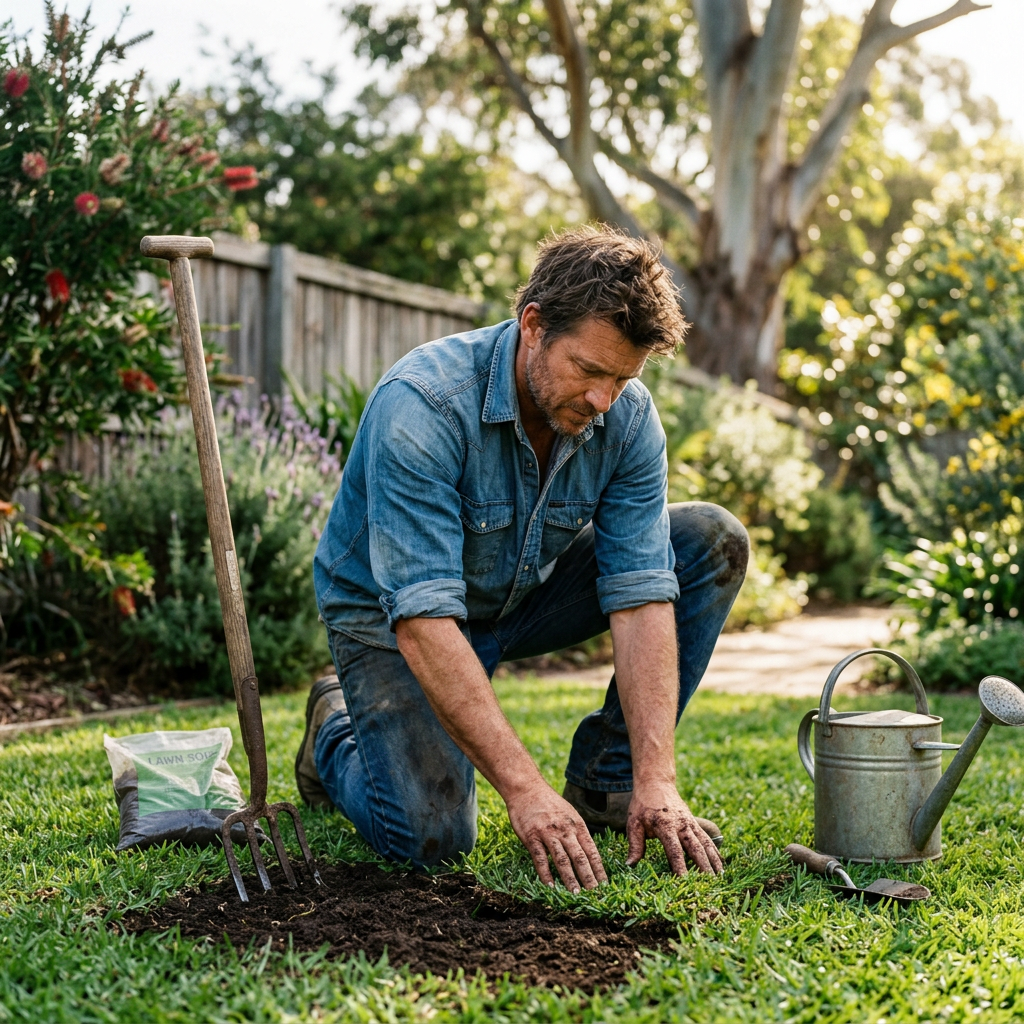
Start by removing the dead grass and any debris, then loosen the top five to ten centimetres of soil with a fork. Mix in a little quality topsoil or lawn soil to give new roots an easy start. If you are seeding, spread the seed evenly, press it into the surface for good contact, and keep it consistently moist for the first few weeks. If you are patching with turf, cut the piece to fit snugly, press the edges firmly against the surrounding lawn, and water it daily until it resists a gentle tug.
Spring in Sydney gives you ideal conditions for both approaches, because warm-season grasses are entering their strongest growth phase. A patch repaired in September or October has months of favourable weather to knit into the surrounding lawn before summer tests it. The same repair attempted in late autumn often sits dormant, thin and vulnerable right through winter.
📋 A Realistic Repair Plan You Can Adapt
If you want a simple starting point, here is a sequence that suits most Sydney lawns in spring. In the first week, walk the lawn and map your patches, noting their pattern and location, then run the screwdriver test for compaction and the overnight sack test if you suspect grubs. In the second week, treat whatever you found: aerate compacted areas, apply a wetting agent to dry spots, deal with grubs, and flush any urine or chemical burns with water.
From the third week, begin the physical repairs, seeding or patching with turf once the underlying cause has been addressed. Water new areas lightly every morning, and hold off mowing them until the new grass is clearly established and growing. From then on, protect your investment with the habits that prevent patches in the first place: mow regularly without cutting too short, water deeply rather than often, and redirect heavy foot traffic with stepping stones or paths where a route has become permanent.
Adapt the timing to your own property, but keep the order intact. Diagnose first, treat second, repair third. It is the difference between a lawn that stays even all year and a repair cycle that repeats every season.
🏡 Final Thoughts
So why does your lawn have bare patches? Because something specific happened in those exact spots: compacted soil, too much shade, grubs feeding underneath, a chemical or urine burn, or water that never reached the roots. Every one of those causes is identifiable with simple tests, and every one of them is fixable, especially in spring when Sydney lawns are primed to grow.
The deeper lesson is that bare patches are feedback, not failure. A lawn that is mowed at the right height, watered deeply, aerated occasionally and inspected as you walk across it rarely develops patches at all, because small problems get noticed while they are still small. Regular, consistent maintenance is quieter than a dramatic spring rescue, but it is what keeps a lawn genuinely even, season after season.
👉 Are bare patches coming back no matter how many times you reseed them? Click here to get a free quote and discover how regular garden and lawn maintenance can identify what is really killing the grass and keep your lawn full, green and even all year round.