💧 Why Do Outdoor Tiles and Pathways Become Slippery When It Rains?
Rain does not make a pathway slippery. It reveals what has been quietly growing there all along.
If your tiles only feel dangerous when wet, the problem was there long before the clouds arrived.
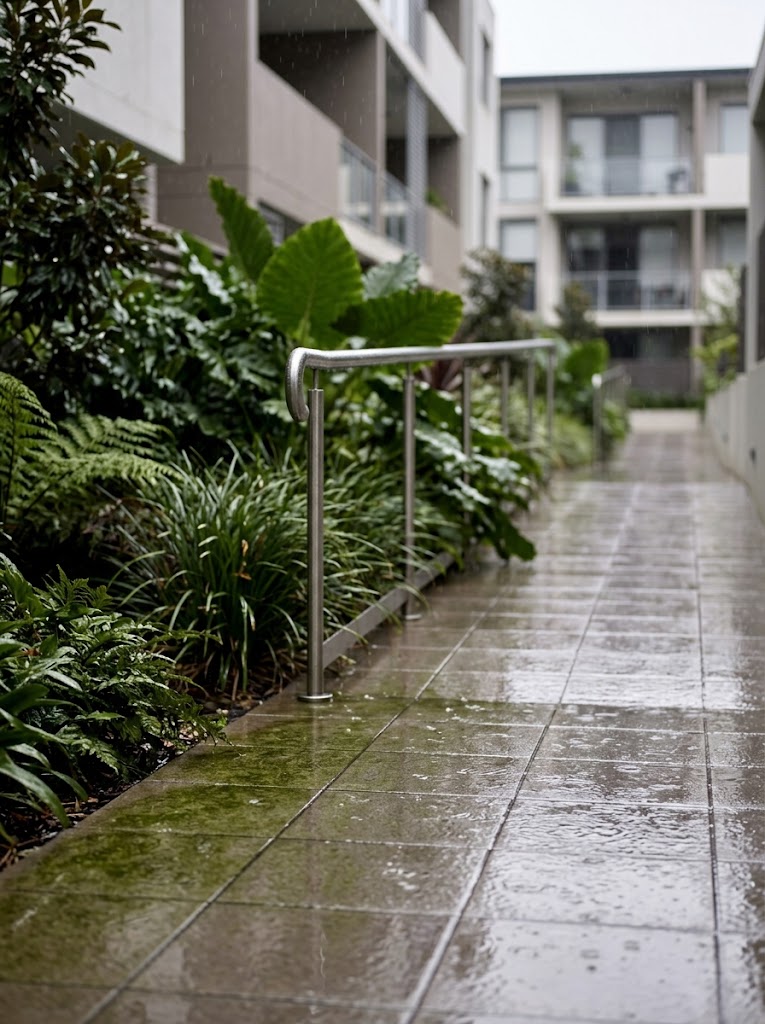
Here is a question worth pausing on: if rain is just water, why does the same path that felt fine all summer suddenly behave like ice on the first wet morning? The path looks clean. Nothing visibly changed overnight. And yet everyone in the building starts crossing it with short, careful steps and a hand near the railing.
💧 Why Do Outdoor Tiles and Pathways Become Slippery When It Rains?
The answer changes how you deal with the problem forever. Water on its own, sitting on a genuinely clean textured surface, actually provides reasonable grip. What makes outdoor tiles and concrete treacherous is what the water mixes with: thin, almost invisible layers of algae, biofilm, mould and organic residue that have been quietly building on the surface for months.
Once you understand that, everything else makes sense: why sweeping does not help, why the same spots turn dangerous every time, and why some areas of a property stay grippy in the heaviest downpour. Let us break it down step by step, so you can find and fix the risk zones on your own property.
🦠 Step 1: Meet the Invisible Layer on Your Paths
Every outdoor surface exposed to moisture and shade slowly grows a living film. Algae arrives first, often as a faint green tinge most people dismiss as discolouration. Biofilm, a thin community of microorganisms, binds to the texture of tiles, concrete and stone. Mould and lichen settle into damp corners, and a season of dust, pollen and leaf residue completes the coating.
The trick is that this layer is nearly invisible when dry. It feels like nothing more than a slightly dull surface. But these organisms are mostly water, so when rain arrives, the film rehydrates in minutes, swells and turns into a lubricant sitting between shoe and surface. That is why a clean looking path can still send someone sliding: the danger was never visible dirt.
🌳 Step 2: Find Your Risk Zones (They Are Very Predictable)
Slipperiness is never evenly distributed, and shade plus moisture is the formula that predicts it. The path on the southern side of the building. The section under the big tree. The corner near the garden bed that never quite dries. These are always the danger zones, because the organisms behind the slippery film need dampness to thrive and die back where sun dries the surface quickly.
Try this after the next rain: walk your property and note which sections are still damp a full day later. Those areas, especially where they meet shade from buildings, fences or trees, are your future slip hazards. Garden beds beside paths add to the effect by raising humidity and shedding organic material, and anywhere water pools is effectively a nursery for regrowth. Mapping these zones takes ten minutes and tells you exactly where to focus attention.
🧹 Step 3: Understand Why Sweeping and Hosing Do Not Work
The instinctive response to a slippery path is to sweep it or hose it down, and neither touches the real problem. Sweeping removes loose leaves and dirt, which is worthwhile, but the bonded film underneath grips the microscopic texture of the surface far too firmly for bristles. Hosing is even less effective, and can spread spores to new areas while giving the growth exactly the moisture it loves.
This explains the frustrating loop so many property owners know: the path is cleaned regularly, looks tidy, and still turns dangerous every time it rains. Breaking the loop means removing the film itself, typically with professional pressure cleaning using the right technique, plus a treatment that kills the remaining organisms where growth is well established. Skip that last step and regrowth starts immediately, and the surface is often slippery again within weeks of the next rain.
🧱 Step 4: Know How Your Surface Type Changes the Risk
Smooth surfaces lose their grip first, but textured surfaces hide the problem longer. Polished tiles, painted concrete and worn stone have little texture to begin with, so even a thin film removes most of their available traction. Textured surfaces hold on longer, but their pits and grooves collect moisture and organic material, letting growth establish deep in the profile where it is harder to remove.
There is also a slow change most people never notice: years of foot traffic polish the high points of pavers and stone, creating smooth patches that become disproportionately slick when wet. The practical takeaway is about priorities. Entrances, ramps and stairs carry the highest consequences for a slip, so they deserve the most slip resistant surfaces and the most frequent maintenance. Where a surface has become permanently smooth, non slip treatments and coatings can restore some texture.
📅 Step 5: Match the Cleaning Frequency to Each Zone
The real safety question is not whether your paths look clean today, but how long since the film was last removed. Surfaces in full sun with good drainage may need professional attention only once a year. Shaded, damp, high traffic zones may need it several times a year to stay genuinely safe. One uniform schedule across the whole property is almost always wrong in both directions: too much in the easy areas, too little in the risky ones.
Timing multiplies the value of the work. In Sydney, growth accelerates through the humid months and long wet stretches, exactly when surfaces are also wet most often. Booking deep cleaning just before the wetter part of the year means your paths enter the risky season with clear texture and full grip. For strata buildings there is a bonus: a documented cleaning schedule shows the owners corporation actively managing a known safety risk on common property, which matters greatly if an incident ever leads to questions.
⚠️ Step 6: Learn the Early Warnings Before Someone Falls
Surfaces give notice before they cause injuries, and the checks take minutes. A green or dark tinge in damp corners is the most obvious sign. A surface that feels faintly slimy underfoot after light rain has an established film even if nothing is visible. And watch how people move: when residents instinctively slow down or reach for the railing on one section of path, they have already learned where the danger is.
Here is a simple test you can do after rain: press your shoe onto the wet surface and twist gently. A clean surface resists; a contaminated one lets your shoe glide. Run this test on your known risk zones a few times a year, especially after long wet periods. The worst way to discover a slippery path is through an injury report from a resident, a visitor or a delivery driver.
📌 A Practical Routine You Can Put in Place This Season
For most Sydney properties, a workable baseline looks like this. Map your shaded, slow drying zones once. Give sunny, well drained areas a professional deep clean annually, and the risk zones two or more visits a year, timed ahead of the wetter months. Between visits, keep drainage clear and trim back vegetation that shades or sheds onto paths, because every hour a surface stays wet is growing time for the film.
Then add the two minute checks: the twist test after rain, and a quick glance for green tinges each month. If a zone fails the test between scheduled cleans, move its next clean forward instead of waiting. This rhythm costs far less than it sounds, because you are concentrating effort exactly where the risk lives instead of cleaning everything, everywhere, on guesswork.
🐾 One More Overlooked Factor: What Travels Onto the Path
Some slippery paths are being refuelled daily by what lands on them. Overhanging branches drop leaves and flowers that break down into exactly the organic residue the film feeds on. Mulch and soil wash out of raised garden beds during heavy rain and settle on the paving below. Even regular foot traffic from lawns carries fine organic matter onto hard surfaces, especially near entrances.
The fix is to manage the supply as well as the surface. Trim back growth that overhangs walkways, keep bed edging in good shape so mulch stays where it belongs, and sweep the leaf drop zones weekly during the heavier months. None of this replaces deep cleaning, but it stretches the time between cleans considerably, and it keeps the film from re establishing at full speed the week after the pressure cleaner leaves.
🏡 Final Thoughts
So, why do outdoor tiles and pathways become slippery when it rains? Because rain reactivates the invisible layer of algae, biofilm and organic residue that built up during dry weather, turning it into a lubricant precisely when people are hurrying to get inside. Shade, dampness and infrequent deep cleaning decide where the risk concentrates, and sweeping alone has almost no effect on it.
The properties that stay safe in the rain are not the ones with the newest tiles. They are the ones where the invisible layer is removed before it matures, on a schedule matched to each zone's real conditions. With the steps above, wet weather stops being a matter of luck.
👉 Do your paths, tiles or outdoor stairs turn dangerously slippery every time it rains? Click here to get a free quote and discover how professional pressure cleaning can remove the hidden buildup at its source and keep your property safe in wet weather.