🗑️ What Can You Put Out for a Council Clean-Up in Sydney?
Before you drag that old couch to the kerb, here is what the truck will actually take.
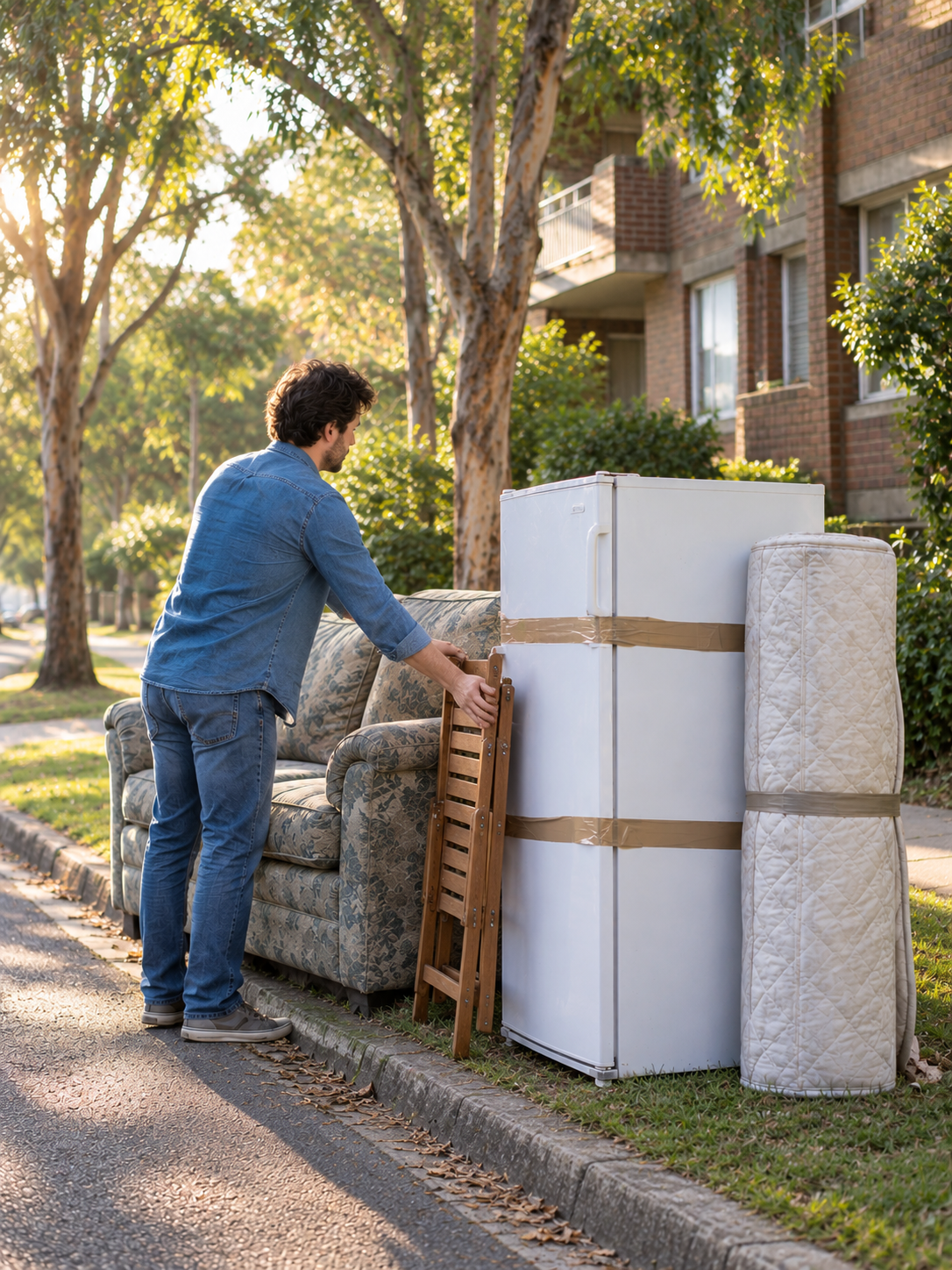
Every few months, the same scene plays out on streets across Sydney. A pile appears on the nature strip: a sagging couch, a bar fridge, a rolled-up rug, a few mystery boxes. Some of it disappears on collection morning. The rest sits there for days, slowly becoming the street's least popular landmark.
🗑️ What Can You Put Out for a Council Clean-Up in Sydney?
If you have ever stood in your garage wondering whether the council clean-up will take your broken bookshelf, your old paint tins, or that mattress the previous tenant left behind, you are asking exactly the right question. Putting out the wrong items does not just mean they get left behind. In many parts of Sydney it can count as illegal dumping, and that can attract fines.
This guide walks through what a council clean-up in Sydney will accept, what it will refuse, and how to time everything so your kerb is clear by lunchtime instead of cluttered for a fortnight. It is written for homeowners, tenants, strata managers and building managers alike, because bulky waste causes headaches for all of them.
🚛 How Does a Council Clean-Up Actually Work in Sydney?
The first thing to understand is that every Sydney council runs its clean-up service a little differently. Some councils schedule collections for your street a few times a year and letterbox you the dates. Others have moved to a booking system, where you request a pick-up online and are given a specific collection date for your address.
That difference matters more than it sounds. On a scheduled system, everyone on the street puts things out in the same week, so a stray pile is easy to spot as early or late. On a booked system, a pile without a booking is simply dumped rubbish, no matter how tidy it looks.
Here is a quick test: search your council's name plus "clean-up" before you move a single item. Two minutes on your council's website will tell you whether you need a booking, how many collections you are entitled to each year, and any size limits for the pile. It is the cheapest insurance you can get against a week of staring at rejected furniture.
🛋️ Group 1: The Items Almost Every Council Will Take
The safest items to put out are ordinary household furniture and fittings that one or two people can lift. Think couches, armchairs, bookshelves, bed frames, tables, chairs, chests of drawers and flat-pack furniture that has reached the end of its wobbly life.
Most Sydney councils also accept whitegoods such as fridges, washing machines, dryers and dishwashers. Fridge and freezer doors should be removed or taped firmly shut so children cannot climb inside, a rule that exists for sobering reasons. Mattresses and bed bases are usually accepted too, although many councils count them separately or cap how many you can put out at once.
Smaller household odds and ends, like toys, pots, luggage and garden furniture, are generally fine when they are boxed or bundled. The recurring theme is manageability. If a couple of collection workers can lift it safely into the truck, it probably belongs in Group 1.
🚫 Group 2: The Items That Should Never Touch the Kerb
Anything hazardous, liquid or related to building work stays off the nature strip, full stop. Paint tins, chemicals, gas bottles, motor oil, batteries and asbestos are refused everywhere, because they put collection crews and neighbours at risk. These belong at dedicated drop-off points, and the NSW government runs regular household chemical collection events for exactly this purpose.
Building and renovation waste is the other big trap. Bricks, tiles, concrete, fence panels, soil and large amounts of timber are treated as construction waste, not household clean-up material, even when the renovation was a weekend DIY job. The same goes for car parts and tyres, which need specialised recycling.
Glass deserves special mention. Mirrors, shower screens and large panes are refused by many councils, or must be taped and clearly labelled, because a shattered sheet in a compactor truck is dangerous. When in doubt, treat glass as a special case and check first.
💻 What About E-Waste, Then?
Electronics sit in a grey zone that changes from council to council, so never assume. Some Sydney councils collect televisions and computers as part of the clean-up, some run separate e-waste collection days, and some ask you to bring items to a community recycling centre instead.
The reason is that e-waste is genuinely valuable when it is recycled properly. Circuit boards, cabling and screens contain recoverable metals, and crushed in a general waste truck they become contamination instead of a resource.
Try this before clean-up day: gather every dead appliance and gadget into one box and check your council's e-waste rules in a single sitting. Households are often surprised to find they own a small museum of retired phones, chargers, kettles and remote controls, and dealing with them once a year is far easier than one drawer at a time.
⏰ Timing: The Rule That Catches Most People Out
A perfectly legal pile becomes illegal dumping if it goes out at the wrong time. Most councils ask that items be placed on the kerb no earlier than the day or two before collection, and definitely not weeks in advance. A pile that sits out too long attracts scavengers who scatter it, weather that soaks it, and neighbours who quietly add their own contributions.
That last problem is real and surprisingly common. A neatly stacked clean-up pile has a magnetic effect on the whole street, and once a stranger's broken TV lands on top, the pile can exceed size limits or include refused items that were never yours.
The fix is simple. Put your items out the evening before collection, stack them compactly with the heaviest pieces at the bottom, and keep the pile clear of driveways, drains, trees and parked cars. A tidy pile is collected faster and leaves less mess behind.
🏢 Why Do Bulky Items Keep Piling Up in Strata Bin Rooms?
In apartment buildings, the clean-up problem moves indoors, and it grows in the dark. A resident moves out and leaves a mattress leaning against the bin room wall. A week later someone adds a broken office chair, because clearly this is where big things go now. Within a month, the bin room has become an unofficial furniture graveyard that blocks access to the actual bins.
Strata schemes face an extra complication: the building usually needs to book collections as a whole, and residents rarely know when that happens or who to ask. The result is that bulky items appear randomly, and the strata manager ends up paying for private removal of things a free council service could have taken.
The buildings that stay on top of this all do the same few things. They display the council's clean-up booking process somewhere every resident sees it, they include bulky waste instructions in move-out communications, and they schedule regular checks of bin rooms and common areas so one abandoned mattress never gets the chance to invite friends. Regular bin room cleaning and waste area management make that inspection habit automatic instead of optional.
📌 A Realistic Starting Point You Can Adapt
If you want a simple routine, here is one that works for most Sydney households and buildings. Once a season, do a fifteen-minute walk-through of your garage, balcony or storage cage and pull out anything you have not used since the last walk-through. Check your council's website for the booking process or the next scheduled date while the kettle boils.
Sort what you find into the three groups from this article: safe household items for the kerb, hazardous and building materials for proper drop-off, and electronics for whichever e-waste path your council offers. Put the kerbside group out the evening before collection, stacked tightly and clear of obstacles.
For strata and commercial properties, add one more layer: a monthly inspection of bin rooms and common areas, with a clear process for reporting dumped items before they accumulate. Buildings that treat bulky waste as routine maintenance spend far less than buildings that treat it as a crisis.
🏡 Final Thoughts
So, what can you put out for a council clean-up in Sydney? Everyday furniture, whitegoods with secured doors, mattresses and bundled household items are welcome almost everywhere. Hazardous materials, building waste, tyres and loose glass never make the list, and e-waste depends entirely on your local council's rules.
The deeper lesson is that bulky waste rewards a little planning. A booked collection, a tidy pile put out at the right time, and a quick check of the rules turn a stressful pile-up into a one-morning job. For strata buildings, the same principle scales up: regular attention to bin rooms and waste areas prevents the slow accumulation that turns into an expensive clean-out later.
Prevention, as always, is cheaper than the cure, and it keeps your street looking like a street instead of a furniture showroom that gave up.
👉 Is your bin room or kerbside slowly filling up with furniture nobody owns? Click here to get a free quote and discover how regular waste area management and rubbish removal can keep your property clear, compliant and complaint-free all year round.