🧼 Removing Oil Stains From Your Driveway: What Works and Why
That dark patch under the car is not permanent, but the clock is ticking.
You notice it the morning the car is not there. Where the engine usually sits, a dark, slightly shiny patch has spread across the concrete like a shadow that forgot to leave. Maybe it has been there for weeks. Maybe it appeared after one visit from a friend's leaky ute. Either way, it is now the first thing you see every time you walk up the driveway.
🧼 Removing Oil Stains From Your Driveway: What Works and Why
Oil stains are one of the most common complaints we hear about driveways, carports and strata visitor parking bays across Sydney. They make an otherwise well-kept property look neglected, and they have a frustrating habit of surviving an ordinary hose-down completely untouched.
The good news is that removing oil stains from your driveway is very achievable when you understand what the oil is actually doing inside the concrete. This article explains why the stains form, walks you through a method that works, covers the mistakes that make stains worse, and shows when a professional clean is the smarter call.
🧽 Why Do Oil Stains Set So Deeply Into Concrete?
Concrete looks solid, but it behaves much more like a very hard sponge. Its surface is covered in microscopic pores and capillaries, and fresh oil wicks down into them within hours. What you see on the surface is only the visible tip of a stain that has soaked several millimetres into the slab.
This is why a quick scrub with soapy water so often disappoints. You are cleaning the surface while the reservoir of oil below keeps rising back up, a little like dabbing at a red wine spill on carpet without ever treating the underlay.
Sydney weather adds its own twist. Warm days thin the oil so it penetrates faster and deeper, and strong sun bakes the residue into a stubborn, darkened crust. The same stain that would wipe up in minutes on day one can take repeated treatments after a summer month of baking in the open.
⏱️ Step 1: Act While the Stain Is Fresh
With any new spill, your first job is absorption, not scrubbing. Cover the wet patch generously with an absorbent material and let it drink up the oil before anything is rubbed in. Clay-based cat litter is the classic choice, and sawdust, sand or even cornflour will do a similar job in a pinch.
Press the absorbent down with your shoe so it makes proper contact, then leave it to work for several hours or overnight. Sweep it up, bin it with your general waste, and you will often find most of the spill never had the chance to become a stain at all.
Here is a quick test worth remembering: splash a little water on the patch after sweeping up. If the water beads and slides off rather than soaking in evenly, oil is still sitting in the pores and the spot needs a proper degreasing treatment, which is Step 2.
🧴 Step 2: Break Down the Oil, Not Just the Surface
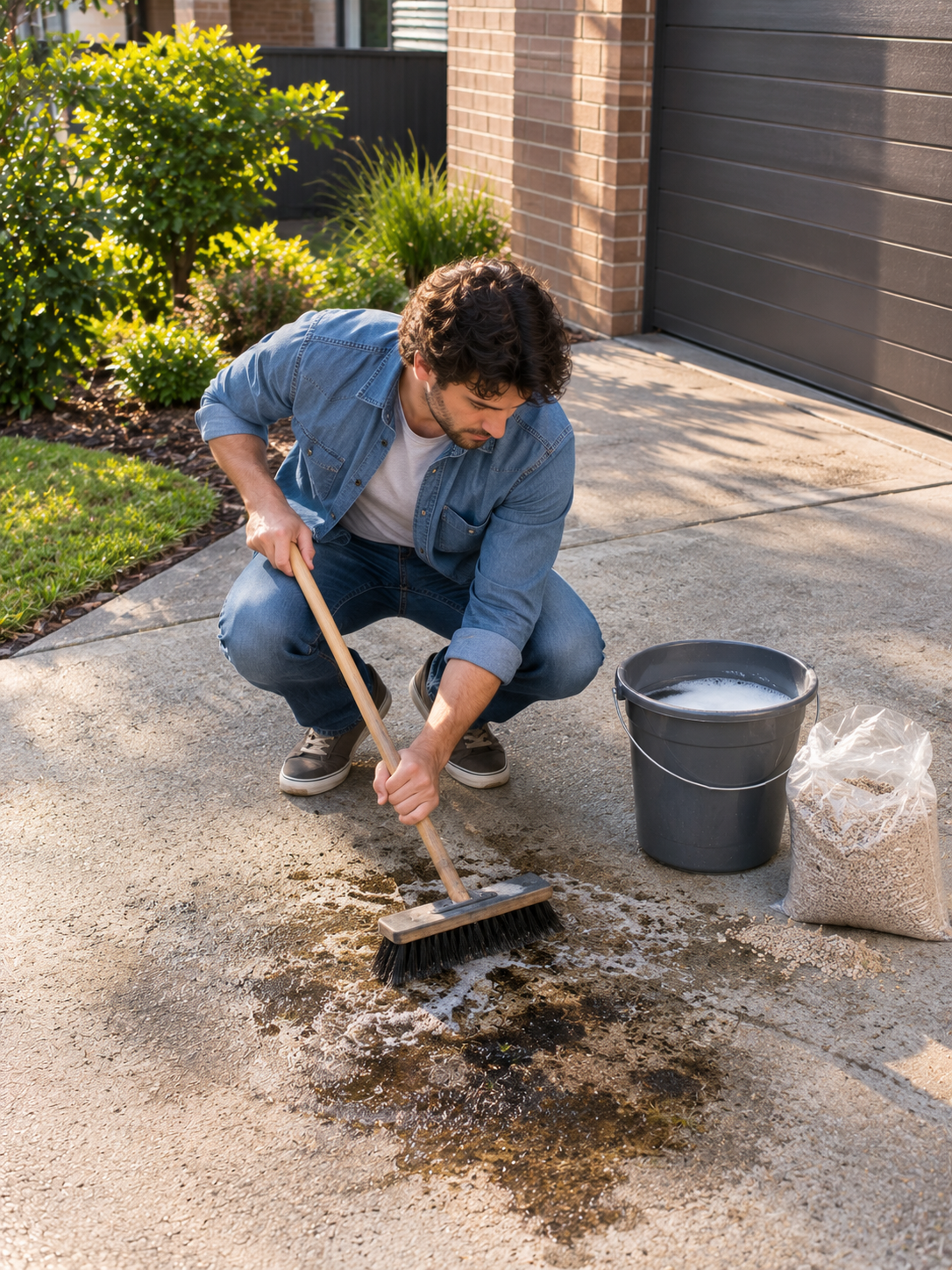
Oil does not dissolve in water, so you need something that chemically loosens its grip on the concrete. A purpose-made concrete degreaser from the hardware store is the most reliable option. For lighter marks, a strong mix of dishwashing liquid and hot water works on the same principle, because dish soap is designed to surround and lift grease.
Apply the degreaser to the stain, give it time to dwell according to the label, and work it in with a stiff-bristled broom or scrubbing brush. The dwell time matters more than the muscle. You are letting the product soak down to where the oil actually lives, rather than polishing the surface above it.
For older, darker stains, try a poultice. Mix an absorbent powder such as baking soda or cat litter dust with the degreaser into a thick paste, spread it over the stain, and cover it with plastic taped at the edges. As the paste dries over a day or two, it slowly pulls the oil up and out of the pores, the same way a face mask draws oil from skin.
💦 Step 3: Rinse Properly and Be Ready to Repeat
A thorough rinse finishes the job, and honesty about the result decides the next move. Rinse the treated area with hot water if you can, sweeping the dirty runoff away from garden beds and stormwater drains. Let the concrete dry completely before judging, because damp concrete always looks darker and can trick you into re-treating a patch that is already clean.
Deep or aged stains rarely vanish in one round. Expect to repeat the degreaser or poultice treatment two or three times, with each pass visibly lighter than the last. Improvement between rounds tells you the method is working and the stain is on its way out.
If three honest attempts leave a strong shadow, the oil has likely penetrated beyond the reach of household products. That is not a failure on your part. It simply means the stain now needs heat and pressure, which is where professional equipment earns its keep.
🚫 What Makes Oil Stains Worse Instead of Better?
The most common mistakes all come from treating concrete like a benchtop instead of a porous slab. Blasting a fresh spill with a hose or pressure washer before absorbing it simply spreads the oil across a wider area and pushes it deeper into the pores. Absorb first, always.
Harsh acids and undiluted bleach are another trap. They can etch or discolour the concrete around the stain, leaving a pale halo that is even more noticeable than the original mark. Wire brushes and angle grinder attachments cause similar damage, scarring the surface so it collects dirt faster forever after.
Painting or sealing over an untreated stain is the mistake with the longest consequences. Oil residue stops coatings from bonding, so the paint peels in patches and you inherit two problems instead of one. Concrete must be clean and dry before anything goes over the top of it.
🕰️ Can Old Oil Stains Be Removed Completely?
Old stains can almost always be improved dramatically, and many can be removed entirely with the right combination of heat, pressure and chemistry. Professional hot-water pressure cleaning softens aged oil that cold water cannot touch, and commercial-grade degreasers reach deeper than retail products. On most driveways, the practical difference is a surface that looks uniformly clean again, even if a forensic eye could find a faint memory of the worst patch.
The age of the stain, the porosity of your particular slab and how many times the spot has been driven over all affect the outcome. A five-year-old stain on unsealed concrete in full sun is the hardest case. A six-month-old stain on a shaded strata driveway usually responds beautifully.
Once the concrete is properly clean, sealing it is the step most owners skip and later regret. A quality sealer closes those microscopic pores, so the next leak sits on the surface waiting to be wiped away instead of soaking in. It is the difference between future spills being a chore and being a shrug.
📌 A Realistic Starting Point You Can Adapt
If your driveway has a mix of fresh drips and older shadows, here is a plan for one ordinary weekend. On Saturday morning, absorb any fresh or tacky spots with cat litter and leave it to work while you do the water-bead test on the older marks. In the afternoon, treat every spot that failed the test with degreaser, scrub, rinse and let everything dry overnight.
On Sunday, assess in full daylight. Re-treat the stubborn patches or start a poultice on the worst one, and take a photo of the whole driveway. Photos matter, because progress over two or three weekends is easy to underestimate when you look at the same concrete every day.
For strata schemes and commercial properties, translate the same logic into a schedule: absorbent granules stored near visitor parking for quick response, a periodic driveway inspection, and pressure cleaning of shared surfaces at a sensible interval so oil, grime and tyre marks never build up to complaint level.
🏡 Final Thoughts
Removing oil stains from your driveway comes down to three ideas: absorb fresh spills before they soak in, use a degreaser or poultice to lift what has already penetrated, and repeat with patience rather than reaching for harsh shortcuts. Old stains need heat and pressure, and once the slab is clean, a sealer turns your driveway from a sponge into a shield.
Like most property care, the real win is catching things early. A tub of cat litter in the garage and a two-minute response to the next drip will save hours of scrubbing later, and a regularly cleaned driveway lifts the look of the whole property, whether it is a family home or a thirty-unit strata block.
Clean concrete does not stay clean by accident. It stays clean because someone made it routine.
👉 Are oil stains and grime making your driveway or car park look older than it is? Click here to get a free quote and discover how professional pressure cleaning can restore your concrete and keep your property looking sharp all year round.