💦 How Often Should Outdoor Areas Be Pressure Cleaned in Sydney?
“The best time to pressure clean a surface is before years of buildup turn routine maintenance into heavy restoration.”
You look at the concrete outside your property and wonder whether it is time to clean it again.
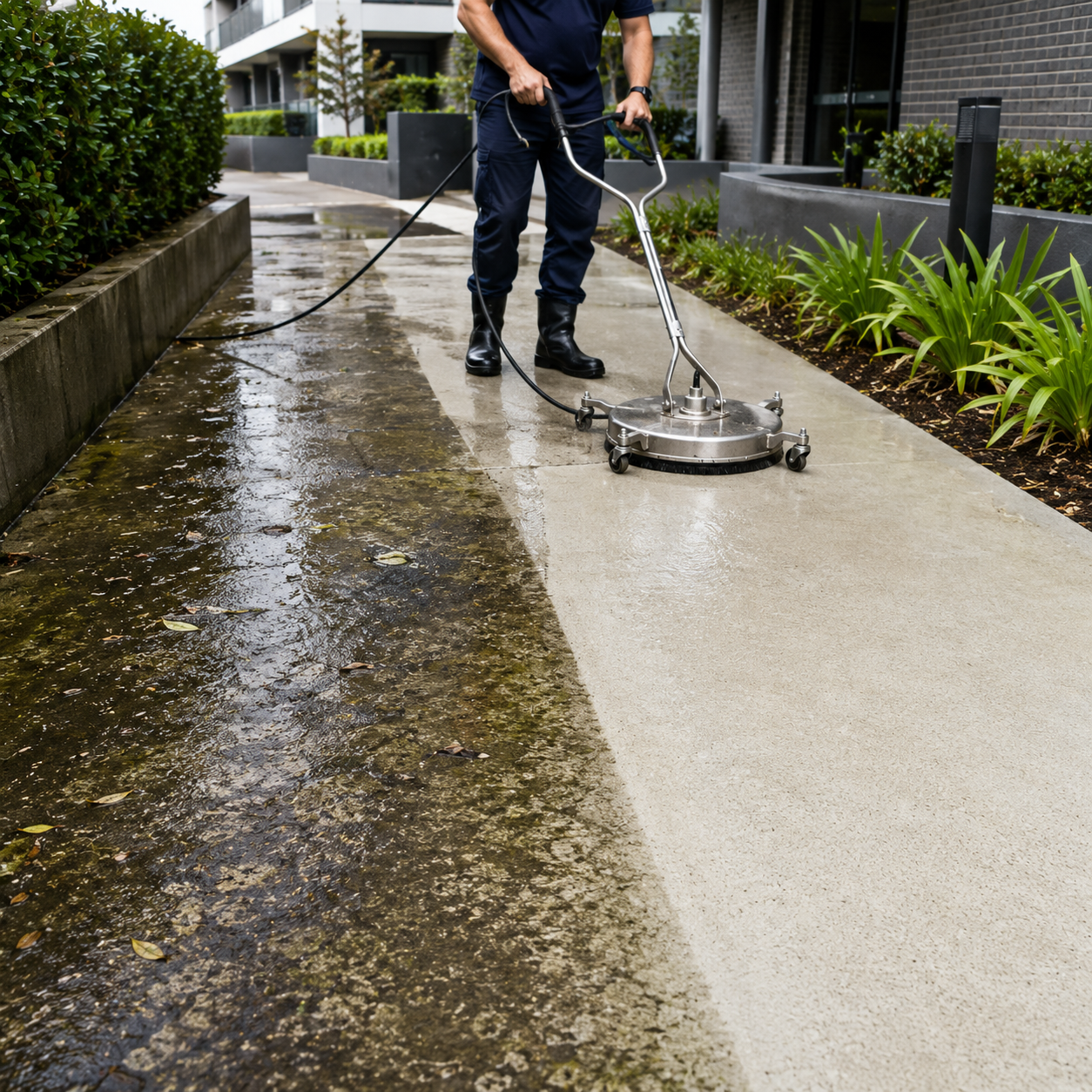
Some areas still appear relatively bright, while others have started developing dark patches near the edges. The shaded pathway remains damp longer after rain, the driveway has visible tyre marks, and the entrance no longer looks quite as fresh as it did after the last clean. Nothing seems urgent, but the difference is becoming harder to ignore.
💦 How Often Should Outdoor Areas Be Pressure Cleaned in Sydney?
This is where many property owners and strata managers become uncertain. Pressure cleaning too frequently may feel unnecessary, while leaving it too long allows dirt, algae, mould, stains, and organic buildup to become more difficult to remove. The challenge is that there is no single schedule that works for every property.
The right frequency depends on how each outdoor area is used, what surrounds it, how much sunlight it receives, and how quickly environmental buildup develops. Understanding those conditions makes it much easier to clean at the right time instead of waiting until the surface looks severely neglected.
📅 There Is No Universal Pressure Cleaning Schedule
Many people want a simple answer, such as pressure cleaning every six months or once a year. While those intervals may be suitable for some properties, they cannot account for the enormous differences between outdoor environments across Sydney. Two buildings located only a few suburbs apart may require completely different maintenance schedules because their exposure, landscaping, traffic, and drainage conditions are not the same.
A sunny residential driveway with limited tree coverage may stay presentable for a long time. A shaded pathway beside dense gardens may begin developing algae only a few months after it has been cleaned. Commercial entrances exposed to constant foot traffic may also need attention more frequently than outdoor areas used by only a small number of residents.
The most effective schedule is therefore based on the condition of the surface rather than a fixed date on the calendar. Regular inspections make it possible to identify early buildup and arrange cleaning before the area becomes heavily stained, slippery, or visually neglected.
Pressure cleaning should be treated as preventative maintenance. The objective is not to clean as often as possible. It is to clean frequently enough to protect the surface, maintain safety, and prevent years of contamination from building up.
🌧️ Shade and Moisture Can Make Surfaces Dirty Much Faster
Moisture is one of the biggest factors affecting how often an outdoor area may need pressure cleaning.
Pathways, courtyards, stairways, and driveways that remain shaded for much of the day dry more slowly after rainfall or irrigation. That extended dampness creates ideal conditions for algae, mould, moss, and other organic growth to develop. The first signs may appear as faint green colouring near garden edges or dark patches in corners where water collects.
Over time, the growth spreads across the surface and begins retaining even more moisture. This can cause concrete, tiles, or pavers to look older and can make walking areas slippery when wet. Simply waiting for the next dry season may not resolve the problem because the organisms remain attached to the surface.
Areas with poor drainage often experience the same issue. Water that repeatedly pools in one location carries soil, leaves, and organic material with it. As the water evaporates, those contaminants stay behind, forming visible marks and feeding further growth.
Properties with extensive shade, frequent moisture, or drainage problems may therefore require pressure cleaning more regularly than open, sunny areas. The underlying source of the moisture should also be reviewed wherever possible, since cleaning alone will not prevent rapid regrowth if the conditions remain unchanged.
🌳 Trees and Gardens Add More Buildup Than Most People Expect
Landscaping improves the appearance and atmosphere of a property, but it also influences how quickly surrounding hard surfaces become dirty.
Trees release leaves, bark, flowers, seeds, pollen, berries, and sap throughout the year. Garden beds can send soil and mulch onto nearby pathways during heavy rain, irrigation, or windy weather. Even well-maintained plants naturally produce organic material that settles across concrete, stone, tiles, and pavers.
If this debris is removed quickly, it may leave little evidence behind. When it remains damp on the surface, however, it can release natural pigments and tannins that create brown or dark stains. Decomposing material can also support algae and mould growth, especially in shaded areas beside dense planting.
Properties with mature trees may notice faster changes during autumn, after storms, or during seasonal flowering and seed production. A pathway can appear clean one week and become heavily covered shortly afterwards, even when the property has a regular sweeping schedule.
Sweeping and blowing remove loose debris, but they do not always remove residue that has already bonded to the surface. Pressure cleaning may be needed when the original colour becomes hidden beneath stains and embedded organic material. For heavily landscaped properties, inspection frequency should increase during periods of high leaf fall rather than remaining identical throughout the year.
🚶 Foot Traffic and Vehicle Use Affect Cleaning Frequency
The number of people and vehicles using an outdoor area also plays a major role in how quickly it changes.
Every shoe carries small amounts of dust, soil, moisture, and street residue. Delivery trolleys, prams, bicycles, pets, and maintenance equipment add further contaminants. In high-traffic entrances, these particles are repeatedly pressed into the surface, particularly when the ground is wet.
Driveways face a different type of buildup. Tyres leave rubber residue, vehicles may leak small amounts of oil or fluid, and dirt from nearby roads is carried onto the property. Turning areas and parking entrances often develop dark marks faster than sections where vehicles travel in a straight line.
Commercial properties, busy apartment buildings, schools, and public-facing facilities may therefore require more frequent pressure cleaning than low-traffic residential areas. Their entrances influence first impressions, and the constant use allows contamination to accumulate more quickly.
Traffic patterns are often uneven, which means the entire property may not need cleaning at the same frequency. The main entrance, loading area, driveway, and most-used pathways may require scheduled attention while quieter sections remain presentable for longer. A targeted approach can keep important areas maintained without cleaning every surface unnecessarily.
🧱 The Surface Material Changes What “Often Enough” Means
Not all outdoor surfaces respond to dirt or cleaning in the same way.
Concrete is porous and can gradually absorb dirt, oil, organic stains, and pollution. Textured finishes may trap small particles more easily than smooth surfaces. Pavers have joints where moss, weeds, and sediment can collect, while outdoor tiles may show water marks, grime, and algae more visibly because of their colour or finish.
Natural stone can require a particularly careful approach because different types of stone vary in hardness, porosity, and sensitivity. Painted surfaces, aged materials, loose grout, and damaged concrete may also require lower pressure or an alternative cleaning method.
This means cleaning frequency must be considered alongside cleaning technique. A surface that shows visible dirt quickly may not necessarily need aggressive pressure. In some cases, more regular but carefully controlled cleaning can be safer than leaving contamination for years and then trying to remove everything in one intensive visit.
Before pressure cleaning, the material and its current condition should be assessed. Existing cracks, loose joints, flaking coatings, or damaged edges need to be identified so the equipment, pressure level, and method can be adjusted appropriately.
The best maintenance schedule protects both appearance and surface integrity. It should never be based only on how much pressure the machine can produce.
👀 Warning Signs That Pressure Cleaning May Be Overdue
Outdoor surfaces usually provide several warning signs before they become severely neglected.
A noticeable change in colour is one of the clearest indicators. Concrete that was once pale may become grey, brown, or green. Pavers may appear uneven because exposed areas remain bright while shaded sections darken. These changes suggest that dirt or organic growth is beginning to cover the original material.
Slipperiness is another important warning. If pathways, stairs, ramps, or tiled areas feel slippery after rain, there may be algae or biofilm attached to the surface. This should not be treated as a cosmetic issue because it may create a safety risk for residents, visitors, customers, and contractors.
Persistent stains, unpleasant odours near damp areas, moss between pavers, visible tyre marks, and black patches along walls or garden edges can also indicate that cleaning is due. Another useful sign is whether routine sweeping or rinsing still improves the appearance. When ordinary cleaning no longer makes a noticeable difference, the contamination may be embedded.
Inspections should take place before residents begin complaining or before a major event, inspection, or property sale. Acting at the first consistent signs of buildup is generally easier than waiting until the entire surface requires restoration.
🏢 Different Properties Need Different Maintenance Cycles
A suitable pressure cleaning schedule should reflect the purpose and daily demands of the property.
For many residential properties, an annual assessment may be enough to determine whether driveways, patios, pathways, and external entertaining areas need cleaning. However, shaded homes, properties near busy roads, and houses surrounded by mature gardens may require attention sooner.
Strata buildings often benefit from more regular inspections because their shared areas are used by many residents and visitors. Main entrances, bin surrounds, ramps, courtyards, pool areas, and high-traffic paths may all accumulate different types of contamination. Cleaning can be rotated so the most affected areas receive attention without every surface being treated at once.
Commercial properties may need a more frequent cycle because presentation directly influences customers, tenants, and staff. Food businesses, loading areas, car parks, and public entrances can also develop grease, spills, tyre residue, and heavy foot traffic that require closer monitoring.
The maintenance plan should remain flexible. A fixed schedule may need to be adjusted after prolonged rain, nearby construction, landscaping work, storms, or unusually heavy use. Conditions change, and effective property maintenance should respond to those changes rather than following a calendar blindly.
💦 Preventative Cleaning Is Easier Than Heavy Restoration
Waiting until outdoor surfaces are almost black may appear to save money in the short term, but it usually makes the eventual cleaning more demanding.
Fresh dirt and early organic growth are generally easier to remove than contamination that has been repeatedly exposed to moisture, sunlight, vehicle traffic, and seasonal weather. Over time, stains can move deeper into porous materials, moss can establish itself between joints, and algae can spread across larger areas.
Heavy buildup may require additional treatments, repeated cleaning, or more time to restore the surface. Some marks may also become permanent if oil, rust, minerals, or organic pigments have remained untreated for too long.
Preventative cleaning interrupts this accumulation before it reaches that stage. It helps maintain a more consistent appearance and makes each service less focused on correcting years of neglect. This is particularly valuable for high-visibility areas that shape the first impression of the property.
Regular maintenance also creates an opportunity to notice changes in the surface itself. Cracks, loose pavers, drainage issues, damaged edges, and areas of repeated moisture are easier to identify when they are not hidden beneath dirt and organic growth.
The goal is not constant cleaning. It is avoiding the point where restoration becomes significantly more difficult than routine care.
🏡 Final Thoughts
There is no single answer to how often outdoor areas should be pressure cleaned in Sydney.
The right frequency depends on sunlight, moisture, drainage, surrounding trees, surface material, traffic levels, pollution, and how the property is used. A quiet, sunny residential driveway may remain clean for much longer than a shaded strata pathway or busy commercial entrance.
Instead of relying only on a fixed annual date, property owners and managers should look for changes in colour, slippery areas, algae, mould, embedded dirt, persistent stains, and sections that no longer improve through routine cleaning. These signs provide a much clearer indication that pressure cleaning is becoming necessary.
A practical maintenance plan combines regular inspections with cleaning at the right stage. This prevents contamination from becoming deeply established while avoiding unnecessary treatment of surfaces that are still in good condition.
When pressure cleaning is planned according to the actual environment, it does more than improve appearance. It supports safer walking areas, protects the first impression of the property, and helps outdoor surfaces remain presentable for longer.
👉 Not sure whether your outdoor areas are due for cleaning? Click here to get a free quote and discover a pressure cleaning approach suited to your Sydney property, its surfaces, and its maintenance needs.